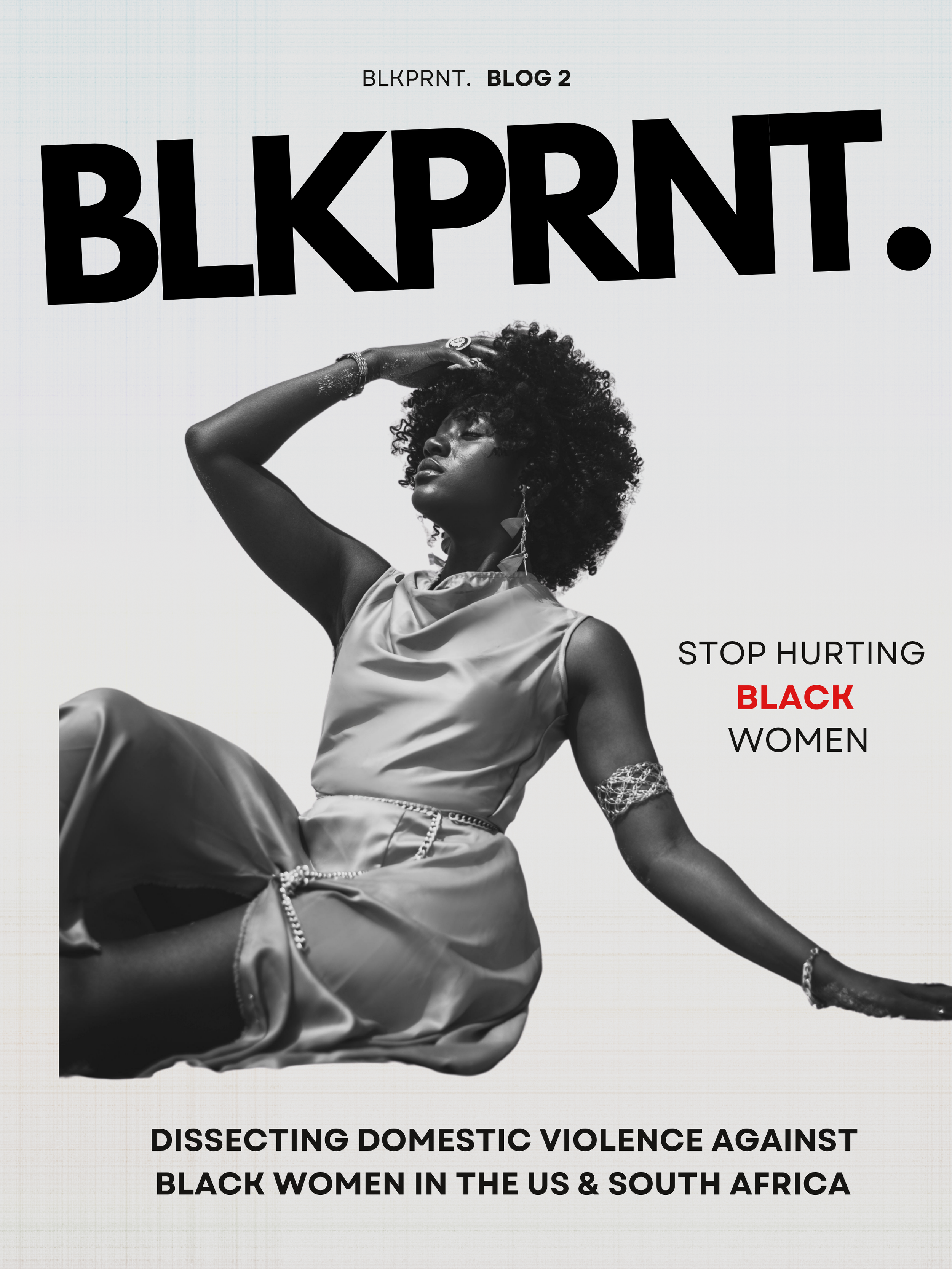
Stop Hurting Black Women
November 24th 2026
There’s a strange ache that hits when you study violence against Black women across the world. Not the quick sting of a headline, but that deeper, familiar throb — the one that whispers, “I’ve heard this story before… just with a different accent.”
On one side, we have Black women in the United States, navigating a system that was never built with our safety in mind. On the other, South African women, living within the borders of a country where femicide rates are some of the highest on the planet. Two places separated by oceans, yet the experiences they face seem to echo each other.
Let’s start here at home:
In the U.S., over 40% of Black women report experiencing physical violence from a partner in their lifetime. The numbers vary depending on the study, but the pattern doesn’t budge: we face higher rates of homicide, higher rates of psychological abuse, and more barriers to getting help than almost any other demographic. And behind every statistic is a mess of structural reasons — economic insecurity, mistrust of police, generational trauma, poor access to resources, and a culture that doesn’t always believe us when we say, “We don’t feel safe.”
Black women know the cost of silence, but we also know the cost of speaking up.
Now shift the lens to South Africa:
The numbers there move with a different sharpness. The country’s femicide rate runs nearly six times the global average. Some studies show that one in three women report physical or sexual violence at some point in their lives, and intimate-partner violence is so widespread that many consider it a “national crisis” rather than a personal one.
The reasons? A long history of apartheid, poverty, gendered power dynamics, cultural norms that still excuse or normalize violence, and institutions that stretched too thin to intervene effectively. When a problem becomes woven into the fabric of everyday life, pulling it out becomes a nation-sized task.
Here’s the part that should sit with you:
Black women in the U.S. and South African women aren’t sharing the same conditions — but we’re sharing the same wounds.
Different histories and different systems, but the same impact.
In the U.S., racism collides with sexism in a country obsessed with individualism and punishment. In South Africa, patriarchal norms collide with economic instability and historical trauma. One place was built on stolen labor; while the other was built on segregation. And in both, Black women are asked to be strong enough to survive it all while being quiet about what it costs us.
Violence doesn’t just live in homes — it lives in systems. And when systems fail, communities step in. But communities can’t do everything by themselves.
What ties these two worlds together is the ignorant idea that Black women can endure anything. That we’ll handle it. That we’ll figure it out. That we’ve been through worse. And while that resilience is real, it shouldn’t be the reason we’re still fighting the same fight on two different continents.
But here’s the part where this story gets lighter. Because even in the heaviness, there’s a thorough-line of possibility.
Across both countries, Black women are building support networks, raising awareness, fighting for laws, creating shelters, calling out culture, and demanding safety. Academics, activists, aunties, friends, and strangers are all pushing back on the silence. The tools differ, but the mission is identical: survival shouldn’t be our only expectation.
Connecting the experiences of Black women in the U.S. and South Africa isn’t just about comparing statistics — it’s about recognizing global patterns. Violence against Black women isn’t an isolated issue. It’s a diaspora story. And if the pain echoes across oceans, the solutions deserve to echo too.
Because when you look closely, underneath the tragedy is a truth we keep forgetting:
Black women have always been the architects of our own protection. The world just hasn’t kept up.
By acknowledging the similarities across continents, we pull the conversation out of the shadows. We stop treating these incidents like isolated tragedies and start treating them like global symptoms of systems that need to be rebuilt instead of patched up.
